

Breeding Giant African Land Snails
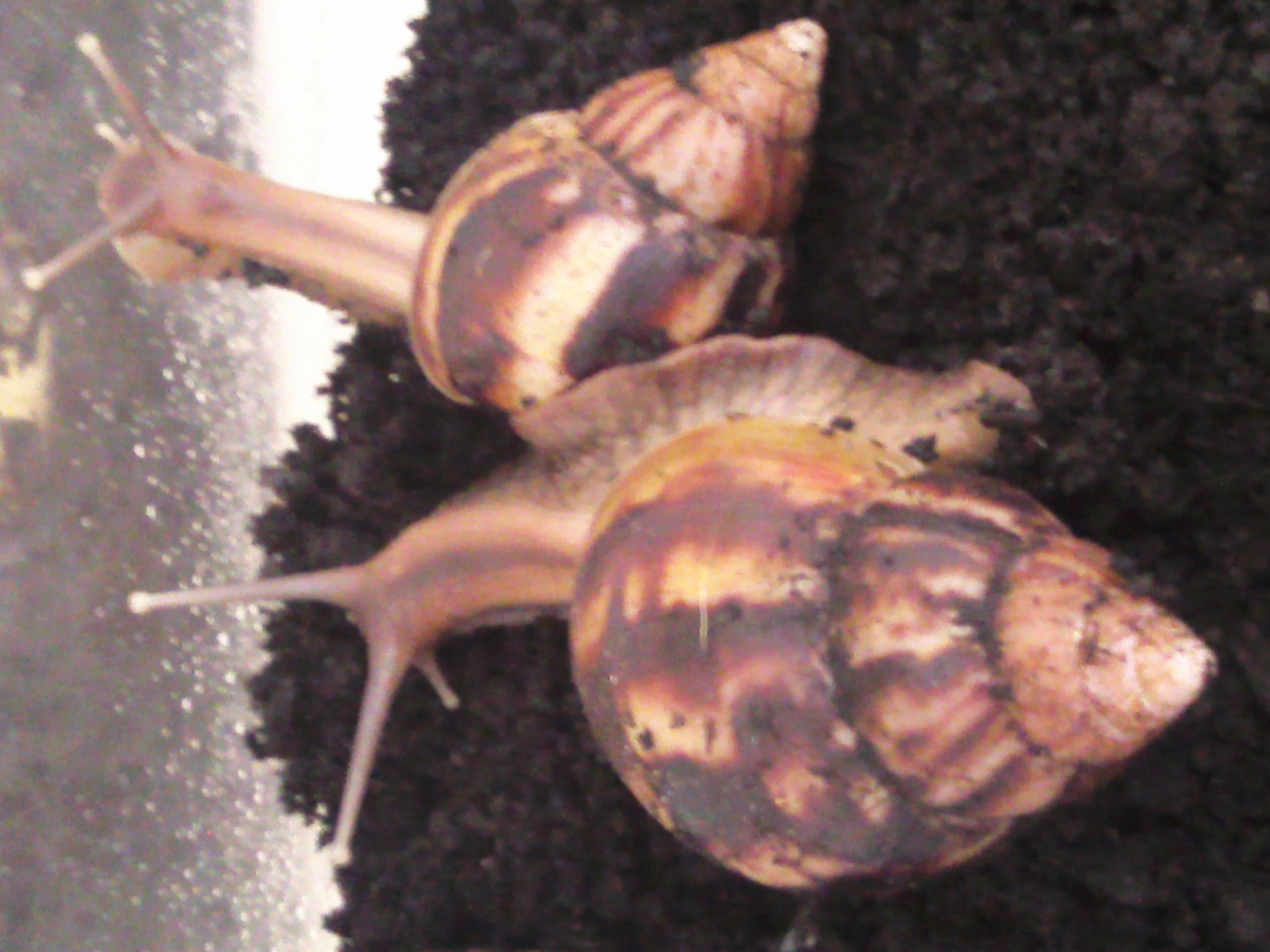 Many people get interested in molluscs by keeping giant African land snails. If you keep more than one giant land snail then you are likely to become a giant land snail breeder, whether you like it or not!
Giant African land snails are hermaphrodites, (each snail contains male and female parts), so any two snails are likely to start breeding. There have been some rare-cases of self-fertilisation although this is a very rare occurrence.
Different giant land snail species breed at different rates. The tiger snail (Achatina Achatina) is believed to have a three-year breeding cycle, whereas the common giant African land snail (Achatina Fulica) can breed up to six times a year.
Different species of giant African land snail are able to breed at different ages. Achatina Achatina are sexually mature at around 22 months, whereas it can only take 5 months for Achatina Fulica.
In general Achatina species lay the most amount of eggs, with up to 400 a time (though not all of them are likely to hatch). Due to both the snails being hermaphrodites, each snail is likely to lay fertilised eggs. These eggs are very small, around 5mm in length.
Archachatina species on the other hand lay far less eggs at around 6-30 per litter. The size of these eggs are considerably bigger than Achatina species eggs, being around 8mm.
Similarly different species of giant land snail will take different amounts of time to hatch. Typically the eggs will hatch after 3-6 weeks however there are some species such as the Achatina immaculata which have hatched after 9 days in some cases.
There is one species,В Achatina iradelei, which doesn’t lay eggs at all but gives birth to live young.
Giant african land snails are exceptionally easy to breed, and in some cases can cause problems due to the vast amounts of young that owners end up with. Suitable homes will have to be found for all the babies. Remember it is illegal to release any giant African land snails or their eggs into the wild due to their their invasive nature.
Before you breed them decide what you will do with the babies; there are a few possibilities:
- Breed them for your local pet shop or garden centre to sell. If you do this, make sure the shop in question agrees to it.
- Sell them to your friends. This isn’t a long term solution though.
- Sell them on the Internet; this is risky though as you won’t know who your selling to and the snails may have to go in the post.
- Breed them for reptile food. You could sell or give this to reptile centres.
- Humanely dispose of them.
You may find that you need to humanely dispose of the young. If this is the case it is best to do it when they haven’t hatched. The best way is to boil, freeze or crush the eggs. I have heard of people popping the eggs as well. When you throw these eggs away after this process make sure that there is no possible chance that they could still hatch as it is illegal for them to be released into the environment, even if it was not intentional.
When cleaning out the tank or vivarium, check the substrate for any eggs. A common way for these snails being released into the environment is that their bedding is being thrown away, without the owners knowing there are eggs in the substrate.
If you are keeping the baby snails and are going to breed them properly, it is best to remove the adults from the eggs and the babies as they could accidentally hurt them.
To stop your snails breeding you will need to separate them; be aware that they may still lay clutches of eggs after up to a year of separation as they don’t lay the eggs until they feel the environment is right for them.
Any questions? Comment below.

 June 6, 2010
В·
June 6, 2010
В·  Maddia (Admin) В·
  59 Comments
 Tags: breeding giant afircan ladn snails, breeding giant ladn snails, breeding land snails, giant african land snails, Giant Land Snail Care, Giant Land Snails В· Posted in: Giant Land Snail Care, Giant Land Snail Information
59 Responses
What’s the best kind of Giant African snail to breed?
All giant african land snails are good for breeding, although they are very prolific breeders! The average amount of eggs for Achatina Fulica is 40-100 eggs per snail – remember when a pair of snails breed each will lay eggs. Giant african land snails can lay up to 6 clutches of eggs a year. The exception to this is Achatina Achatina which is believed to have a three-year breeding cycle, although they lay about double the amount of eggs.
If you only want small clutches of eggs then the Archachatina species (e.g Archachatina Marginata ) as they only lay 5-10 eggs per litter.
There is one species of giant african land snail, Achatina iradelei, which gives birth to live young.
Generally Archachatina species lay less eggs than Achatina species.
nice post on breeding giant african land snails. Very informative – thanks.
Well my giant african land snails have had to set of eggs , theres now about 8 hundred and i dont know what to do , also i dont want them any more and no one will take them .
can you help me please ? tell me what to do with them
Thanks
madi
Hi Madi, there are a number of things you could do with the giant African land snail eggs.
You could see if a local pet shop will take them (either to hatch and sell or use as reptile food) – this is what I do with any my snails produce.
Another alternative would be to sell them on ebay (if this is allowed – last time I checked it was ok to sell them as reptile food).
Many owners choose to humanely get rid of the snail eggs, this tends to be done by either freezing the eggs for around 36 hours, or by boiling them.
If you don’t want the actual snails any more see if a local pet shop would like them – they are becoming more and more popular as pets, so many stores are likely to be keen to take them on.
It is illegal to release giant African land snails and their eggs into the wild, whether it is intentional or not.
Hopefully this has helped – If you have any more questions feel free to leave another comment.
My friend found a small slug like baby with his african land snail… We assume its a baby (as we may have missed disposing that egg) so we’ve put it in a different vivarium its growing considerably well however it doesn’t have a shell? Is it a snail baby and will a shell grow?
Hi Kelly,
I believe that usually giant African land snails are born with their shells, or at least they should develop properly within a few days. With my baby snails they hatched with their shells fully-formed. Now, the first thing that sprang to mind when I read your question is that it probably isn’t a snail at all. If you use a ‘soil’ based substrate such as compost then it is likely that other creature’s eggs and small invertebrates will be in the soil; in your case this ‘slug like baby’ could have got into the vivarium with the substrate, either already in this form or not yet hatched. You could check through all the substrate before it goes into the vivarium but it would be incredibly hard not to miss something. Such ‘parasites’ are unlikely to significantly harm your snail, although I would recommend moving them as soon as you see them. You can reduce the chance of having such creatures in your snail’s home by regularly cleaning the vivarium and changing the substrate, and by removing any uneaten food before it goes rotten.
Of course this unusual baby may be a snail after all and it may grow a shell soon, so it may be worth keeping it in a separate vivarium and seeing what happens.
Hopefully this has happened – let us know what happens!
Hey :)
You say that they wait until they feel the environment is right for them.
can you tell more about what is the right environment for laying eggs, do they have a special time of year they are more “willing” to breed then others?
thanks for a great site :)
Hello, usually giant African land snails will breed all year round provided they have the correct conditions. This means that the temperature has to be as near to the temperature that they’d have in the wild in their native habitat; this means in the winter they’ll need some sort of heating equipment that is designed for them. It is vital that all pet land snails are in a vivarium that is at the right temperature for them throughout their whole life, regardless of whether they’ll be breeding or not. Some research has shown that snails are more likely to breed in the summer months, but this may just be down to a better temperature.
Similarly, some research has shown that too little substrate in their vivarium or tank can discourage breeding, as many snails will want to bury their eggs. Fir this reason I’d recommend about three to six inches of substrate at the bottom of the tank. Remember snails like to burrow!
Most importantly the conditions snails should be kept in should be clean and free of decaying food, insects e.t.c. The healthier a snail is the healthier babies it is likely to produce.
giant African land snails are very prolific breeders so you have to know what you’re going to do with the babies before the snails are breeding: some snails, depending on the species, lay up to 300 eggs per clutch, and they will have several clutches throughout the year, with both snails laying eggs.
Hopefully this has helped you :)
Hey :)
Thanks for you reply it was very helpfull.
what size of tank would you recomment for a pair of achatina achatina if they should lay eggs?
Does albopicta and Fulica require less space or is it general the same as achatina achatina for laying eggs.
again thanks for a great site :)
Hi,
Generally the tank size depends on the size of the snails; Achatina Actatina are one of the largest snail species and in some cases they can be up to a foot long (their foot, not the shell!).
My opinion is that any snail, regardless of size, should have as big a vivarium as possible, within reason. This way they’ll have lots of room to explore and more space, which you could replicate their natural environment in. Although, you should never put rocks or stones in the tank asthe snail may break its shell if it lands on a hard material after falling off the roof.
I have one Achatina Achatina juvenile snail which I keep in a Geo Maxi vivarium. This range is designed for fish, but I find the vivariums to be excellent quality. (In fact, here’s a link to the one I have: http://www.feedem.co.uk/small-animal-c129/small-animal-accessories-c176/cages-c177/ferplast-plastic-animal-p10598) The size of mine is (Length) 41.3cm x (Width) 26 cm x (Height) 29.8cm.
I have a range of smaller vivariums too that I use in the winter as I find they conserve the heat a lot better than large tanks
You may find that if your snails are still growing, you’ll need a bigger tank later on, so it may be best to start with a pretty big tank in the first place.
Once your snails have layed the eggs I’d recommend moving the eggs to a separate vivarium ready for them to hatch without the adults interferring.
In general, I think that the bigger the vivarium the better, no matter what snail species is being kept, so long as a correct temperature can be maintained throughout the year.
Hope this has helped you!
Hello, great article very informative and helpful.
I was hoping you could help, my children’s uncle has given them a giant African land snail egg to hatch.
They’ve very excited, as am I.
However, their uncle doesn’t know which species the egg is from and I would be interested to know. His information is the parents were big, brown with a pointy shell, but he didn’t take too much notice, he just knew we all like all animals and take an interest in all inverts, so brought the egg for the children. The egg is about 2cm in length, very similar to the size of a cadburys mini egg but it’s a pale yellow colour.
Also what is the best way to keep it while we wait for it to hatch, we currently have it shallowly buried in coconut fibre substrate at room temp in a small container, I was going to put a heat mat under it but as a small container didn’t want to over heat it, it’s out of any drafts so should be around 20+’c.
Many thanks.
Hi Joanna, thank you for your comment!
At this stage it would be hard to correctly identify your snail egg. You’ve a better chance of identification once the snail is about two or three months old. The most common type of giant land snail is Achatina Fulica: http://www.madelinedyer.com/giant-african-land-snails-achatina-fulica/ These have a light brown or even yellow shell with a slight zigzag pattern, although not all do have the pattern.
Here’s the link to a page giving links to more posts on the different species: http://www.madelinedyer.com/category/giant-land-snails/giant-african-land-snail-species/
2cm sounds like a very big egg for a land snail of any kind, but as far as I can see you are keeping the egg is suitable conditions, although you may need to mist the container with water.
Remember when it hatches it will need special care: misting of tank regularly, calcium supplements (cuttlefish bone), suitable food and heating, particularly in the winter. It will also need a tank that is big enough, ( around 2ft by 1ft by 1.5ft) which will need to be heated to keep it at a constant temperature.
Note: Because snails are burrying creatures heat mats should NEVER be placed underneith the tank or vivarium. Instead they should cover half of one wall (the mat being on the side the snail can’t reach) to create a gradient affect.
I will just mention that a lot of baby snails don’t make it through their first few months (and some won’t hatch). When I was a teen I got three snails and only one survived to be six months old, although these were a rarer species that often don’t survive in the wild. I just thought I’d mention this, to warn you in case. But I’m sure that everything’ll be fine. The better conditions they’re kept in, the higher the rate of survival is (and in general the bigger members of the species are more likely to survive).
There’s lots of information about snail keeping on this site, so if you’re not sure on something see if we have the answer, or ask another question.
Hopefully this has helped you! Feel free to post more comments and let us know of your snail’s progress. (I’d be more likely to identify he/she once the snail is around three months old).
great, thanks for advise, it’s very much appreciated :0)
I knew it was a long shot trying to I.D an egg but was just curious because of the size! was expecting a round and smaller egg than this one, guess it makes it quite exciting though!
I have an exotics pet shop around the corner, so as soon as it hatches, I’ll be there buying all little ‘Gary’ (my kids named the egg! :0s) all he/she needs.
Thank you again for all your help
plz!!!!!!!!!!!!!!! cheack my web site giant african land snails. I am breeding them with my familey we have had 237 successful breeding pairs out of 263. Iv’e got 892 eggs and I just got some new eggs 27 of them I love giant african land snails so im looking for one big and one small to breed. Thanks!!!!!.
how long o achatina fulica eggs take to hatch
The incubation period for Achatina Fulica is generally a couple of days: around 2-8 days, depending on individuals involved. However it can take up to three weeks for hatching to take place.
Hi was wondering if you could help me, my daughter has some Giant African Land Snails and wants to breed them, but she has found out that she can only do one batch from the snails she has because of inbreeding issues. She has Immaculata and Reculata can you tell me which other species she should breed them with please?
Hi,
I’d buy some more snails of the same species so you breed Reculata with Reculata and Immaculata with Immaculata. This is mainly because you shouldn’t keep different species in the same tank or vivarium together, as they wouldn’t necessarily live together in the wild. Also it is very unusual that different species will be able to breed together.
Hopefully this has helped you.
Hi, My friend has given me one of her African land Snail eggs,Is their any special way I should keep it well still it its egg? And also, how can I tell if it will hatch or not? This is my first time with one of these pets. Thankyou so much, Talia.
Hi, just give it the same conditions you’d give it as you would if it had already hatched. So a warm vivarium, out of direct sunlight. You’ll need to mist the tank daily to keep humidity levels correct too. Have a look at some of the articles on this website.
http://www.madelinedyer.com/breeding-giant-african-land-snails/
http://www.madelinedyer.com/how-to-make-a-suitable-home-for-your-giant-land-snail/
http://www.madelinedyer.com/giant-land-snails-as-pets/
And as for the hatching, you can’t really tell when it will hatch. And remember, not all eggs do hatch – that is one of the reasons why they lay so many.
– Hopefully this has helped you.
Our snails laid some eggs but we hadn’t realised therefore about 30 have hatched. We’ve tried hard to rehome them but only managed to give away a few. We have asked pet shops etc. Is there a humane way of disposing of the baby snails? We are careful now and any more eggs have been disposed of in the freezer and have now separated the large snails.
Hello, sounds like you have a tricky problem. My normal answer would be:
Once snails have hatched, there isn’t really a humane way to dispose of them. Instead you can:
-rehome them, ask friends, local schools (science departments) e.t.c
– sell or give them to pet shops (either to sell or as reptile food)
– sell them on ebay (although this only usually applies to the eggs when listing them as reptile food; you can’t sell live animals on ebay).
– sell them on the internet (can be risky).
It seems that it’s easier to sell or get rid of the eggs than the hatchlings. How about asking around garden centres with pet centres in them. Or put up posters and advertise too.
It is illegal to release these snails into the environment as they’re an invasive species.
From what I know there isn’t really a humane way to dispose of the baby snails. I’ll keep thinking and update this comment should I think of anything else.
Sorry I couldn’t be of much help. Good luck.
Hello, thanks for the information, very informative.
I was just curious of two things: Are all the eggs a Giant African Land Snail lays likely to be fertile, thus, likely to hatch?
Also, what do the young tend to do once they hatch? Do they immediatly burrow, hide, look for food etc.?
Thanks in advance!
Hi Ryan,
Not all of the giant African land snail eggs are likely to hatch from any one clutch. The percentage that do will depend on a number of factors, from the temperature of the environment to the species of snail that it is. Typically, you can’t expect all the eggs to hatch, I heard of one owner who’s snail laid 60 eggs and only 2 hatched, then other owners had around 90% hatching; there really is no guarantee. And remember many snails will die during the first few months.
As soon as snails hatch they’re likely to look for food, this is why you should provided them with some (the same food that the adults have) and remember to make sure that they too have a cuttlefish bone or some source of calcium. How the babies act will often depend on their personality and their environment; some will start looking around and exploring straight away, others may burrow into the substrate. If it’s cold they’re more likely to burrow.
Hopefully this has helped you!
I have 2 snails and he/she won’t move outta certain spot
There alive cuz I checked and I was wondering.if hes having eggs. I hhlave 2 , Simon slime and Colin cucumber and there.just over 2 year old so can they have babies? ??
Hi, snails reach sexual maturity at a very early age, so yes they’re old enough to reproduce.
If they haven’t moved for a while, it is possible that they are going to lay eggs soon, however they often bury down into the substrate to do this.
Alternative reasons why he or she might not be moving:
– too hot
– too cold
– humidity levels are not right
– lack of calcium in their diet (remember cuttlefish bones!)
– hibernation
– illness.
Let me know what happens, and if you have any further questions post another comment. (Sorry for the late reply).
Hi
I rescued a GALS about a year ago, I only have the one however I have just noticed it has laid around 50-70 eggs. Does there have to be 2 snails for breeding – most sites suggest so!?!
Hi Sarah,
Firstly, sorry for how late this reply is.
Now, usually GALs do need two individuals to breed, as they are hermaphrodites, but I have heard in some unusual cases of a snail reproducing solely by itself. This is unlikely.
You say you only have one snail, so it could’ve reproduced by itself. However, has your snail ever been with another snail or snails? Often, snails can mate and the eggs are fertilised, yet they only lay them when the environment is absolutely perfect in order to give their babies the greatest chance of survival. Indeed, they can ‘hold’ these eggs for a very long time (up to three years in some remarkable cases!), so it is possible that this has happened to your snail.
i know this has nothing to do with breeding but,
my GALS have just been lying on their cuttlefish not doing anything at all not even eating until this morning only because i moved them next to it (only a little bit of cucumber) i have two i did have 6 but 4 of them went to a new home.
the soil i’m using they have had it for a few months now.
when they are lying i mean they are fully out stretched along the cuttlefish i can’t seem to find any info on this on the internet. they have been like this for about a week now. They have a heat mat and the soil is about 2-4″ deep. i have no idea what’s wrong with them.
any ideas would be fab thanks in advance! :)
Ok, often in cold weather or when they’re coming out of hibernation GALs will show dormant behaviour. However, when showing such behaviour they are usually tucked into their shells, not stretched out.
Is it very hot in their tank and are the humidity levels correct? Do you regularly use a mister, and are they out of direct sunlight?
I’d check the temperature in their tank — check what temperature their breed should have (if you don’t know what breed they are, describe them and I’ll try and help!) — and adjust accordingly. It could be too hot, or two cold. Remember the heat mat should be on only half of one side of the tank, to create a heat gradient.
Try gently spraying some water at the snails’ bodies. They should immediately react and go into their shells. If not, there may be a medical problem.
Hopefully, this has helped. Let me know if you have any further questions and sorry for the late reply!
Thanx a C c lot for the website but one last thing do African land snails make noises in ?? the process
African land snails don’t usually make noises and form what I’ve read, everything says that they don’t… However, from personal experience I’ve found that they do sometimes make a clicking noise, especially when eating.
Hi thanks for the info! they look like the ones in your pic, they have been moving around and eating a lot more this week. i do spray them everyday its not really hot but its not cold either, i’ll have to get a temperature gage for them, they are not in direct sunlight, yeah they do react to water being sprayed onto them, it’s not really humid, i’ve got them in a old fish tank witch is plastic.
thanks :)
Ok thanx
thanks it helped me alot since i only just got 2 giant african land snails and wondered how long it takes for them to breed
Hi
Cane you eat african land snails
JAN
No, it is not recommended that you eat african land snails as some carry salmonella. African land snails are usually kept as pets, not eaten!
Tanx for the insight you have given concerning snails.
I want to start snail farming and would want to do it in a tank. The problem I’m having now is that there Is no enough loamy soil, the type that the snail would have preferred.
My question is, if I used sandy soil for them and moist it everyday wil it be okey for them or must it be loamy soil? The specie of snail I want to farm is African giant
Hi, I, personally wouldn’t use sandy soil for them as it can be too abraisive on their shells.
I’d reccommend cocoa fibre, or coconut fibre as the substrate.
Never use a substrate that is very acidic or alkaline.
(Also, ‘African giant’ isn’t a species, but the most common species used as pets is Achatina Fulica).
Hi There
Our Gal has just layed thier first ste of eggs, she has buried herself under the compost. How long will she be under the compost for? when sould we start to get worried about her comming back up?
Thank you
Hi Sue,
When snails lay their eggs they tend to bury themselves for a couple of days at the most. Any time longer than this, and I’d suggest you check she’s ok, as she should still be eating properly.
Hi,
My snail was only just under 10ml long when we got her and I was under the impression that this was too young to mate.
However she has laid 6 eggs and will be 3 yrs old this august.
She has been kept on her own in her viv since we got her.
Is it possible?
Claire
Hi Claire, this is entirely possible as snails can hold onto their fertilised eggs for a long time, and only lay them when they feel the enviroment is right for them. This is likely to be what has happened, but at least you know that she is happy in her vivarium, as she feels it is a perfect place to raise her babies.
For most land snail species, 3 years of age is definitely old enough to breed. Remember any two snails can breed, with both snails producing young from one mating.
Hi, I need some help desperately. My teacher gave the class two African Land Snails each last year. I checked on then this morning and saw pressed up against the glass one of them laying LOTS of eggs, they are a creamy white colour the size of polystyrene balls. I’m pretty sure my teachers were tiny see-through eggs though!
Also, is it legal to boil them and feed them to our chickens? Because me and my mum thought they wernt beig treated well enough and would die, but they’re thriving! Please can you help me?! I need to know desperately! Thanks :)
Ok, snails will always breed and what you do with the eggs is an important part of snail keeping.
The laws regarding egg disposal are different in different countries, but I believe for most it is ok to boil or freeze the eggs, or use them as reptile food. Of course, the most humane way to dispose of them is boiling or freezing.
Once the eggs have hatched you shouldn’t really feed them to other animals. Instead, you could sell or give them to garden centres/pet shops/friends, but make sure they have good homes.
It is illegal to release giant land snails or their eggs into the wild, whether intentional or not.
If you’re worried about the actual snails’ welfare then it may be best to contact authorities, or if you’re able to, to give them a new home. Being unable to see the exact situation, it is impossible for me to judge this properly.
Hi i have just brought 2 giant land snails,and was given little information about them except they were very easy to keep,the food they need and what to keep them in.Unfortunatly i wasnt awear of the mateing which took place last night and the hundreds of eggs they could lay ,i do not wish to breed them ,i was told if i only put a small amount of compose in the tank like a inch or so they will not lay the eggs as they dont have anough soil to hide them in ,is this true ? and will it harm the snails if they dont have anough soil in the tank ? Also how offten do you recomend cleaning them out and how often should i check for eggs,and are they easily recognised? to despose of,sorry for so many Questions i am really worrid iam going to miss the eggs and cant have baby snails everywhere, can you help me with some advise maybe i shoul split them they are in a larg tank together??? many thanks
Hi, just putting a little amount of substrate into the tank, will not discourage breeding. The only way to be sure you won’t end up with babies is to separate the snails completely.
If you don’t have enough susbtrate, there is a possibility it could harm the snails as they like to bury themselves in deep substrate, as they would in the wild.
You should clean out the tank every weekend, and go through all the substrate carefully looking for eggs. In general, eggs are a pale colour, and are layed in clusters so they’re quite easy to see, although the numbers of eggs layed will depend on the species.
A humane way to dispose of the eggs is to boil or freeze them, however you could see eggs as reptile food, or hatch them and sell them to garden centres/pet shops/ friends. Wherever they go, it is your responsibilty to make sure they’ll be well cared for.
If they’re in a large tank now, maybe you could put dividers in, separating them? That way the snails will be on their own, but still able to see one another.
Hello,
I’m getting Albino Land snails but gettin 5! And I’m worried about breeding! I love snails to bits but don’t want to many babies around but I’m getting 5!!? What should I do? Help!
Breeding dilema!
Hi, there’s not really any guaranteeable way to stop 5 snails breeding, other than to separate them into 5 containers, as any two snails can and will breed.
Some people believe if you only have a little layer of substrate, this discourages breeding, but I believe this to not be the case.
Whatever you do, make sure the snails are cared for properly, and that any eggs are dealt with appropraitely, or that the babies are found suitable homes.
Hey :) great website!!
I just wanted to find out what has happened to some of my snails – one of the biggest has already died, and most of the rest’s insides have all poofed out to the ring of the shell ( the outside bit ). You can see a sort of squishy flesh coming out of their shells. The snail that died, the poofy stuff got worse and worse, but some of the snails i have now are getting better. i have 5 snails in a quite big container now, so hopefully they’ll be ok. thanks for your help, Amy x
Ok, well I have never experienced this, but I would suggest that if your snails don’t get any better within a few days then you should take them to a vet who specialises in exotic pets (yes they do exist!).
In the meantime, check that their habitat is the right temperature, and that the humidity levels are just right for that particular breed.
Sorry I couldn’t be much help.
Ok, well it depends what speciesthey are, as different species mature at different ages.
My giant ghana African land snails didn’t breed until they were about 10 months old, however I can’t say that this is the same for you.
The most common pet snail is Achatina Fulicia, and these reach their adult size at around 6 months of age, and are usually capable of reproduction at this time.
To avoid breeding, separate the snails into different containers as soon as possible (although some snails can breed at very young ages, then not lay the eggs until they feel the environment is right for them – so you could still be surprised).
Hi, my giant african land snails are growing well and I have had them since may. They spend alot of time hanging from the roof of the glass tank I have them in. One has just begun to drop small but bright yellow eggs as she is hanging but only 3 in one day. They have damp compost of at least 2″ and I realise through reading above there should be alot more eggs and they should be down in the compost, also nobody mentions the bright yellow colour, please can anyone advise. I have removed the eggs into a ventilated box on compost and put the back in the tank.
I believe it’s unusual for a GAL to drop eggs whilst hanging. Are you sure they’re eggs?
– J. A
Hi, My G.A.L. has laid two eggs. I’ve had it since it was 12 weeks old and it has never been in contact with another snail. I have placed the eggs in a separate container to see if they will hatch. Do you think they will hatch or just be duds? I’ll keep them but I’m worried now incase my G.A.L. will lay more.
It is possible that the eggs will hatch. Also, with GALs being hermaphrodites, there are some cases of self-fertilisation, so this could be what has happened. This is very rare though, and with such individuals, I don’t believe that a large number of eggs are produced.
Hi, I’d just try to look after the eggs in much the same why that you’d like after the adults, although you might want to have the vivarium a little warmer.
Here’s a link to an ebook about giant land snails as pets: http://www.amazon.co.uk/Giant-Land-Snails-Animals-ebook/dp/B008N96IDI/ref=sr_1_2?ie=UTF8&qid=1342860615&sr=8-2&keywords=giant+land+snails+as+pets
You could also phone up your local garden centres or pet shops which have GALs and ask for their opinion?
(so sorry for the late reply!) Hopefully this has helped you a little.
– J.A
I would keep as many eggs as you are prepared to look after when they hatch. And be prepared, as these may breed too when they’re older.
As for your question about whether the colour of the eggs is normal, I’d need more info, such as the species of giant land snail that you have, the age of the snail, etc.
– Madeline